Posts Tagged ‘Jakks Pacific’

Fall Toy Preview: A Little Grumbling Despite The Full Dance Cards

Friday, October 30th, 2009

My experience at the Dallas Fall Toy Preview was that the overall mood was “workmanlike”.  While I can’t say that people were exactly upbeat, there wasn’t the pervasive sense of gloom that we’ve seen at the last few trade shows.  Most people seemed to give off more of a sense of being survivors, of being beaten up but having made it through with the knowledge that the worst is over but that there are still some tough miles ahead.

In the weeks leading up to the show there was a lot of talk that Target and Wal-Mart (both extremely early price choppers this year) were not planning to attend.  I hear that before every trade show and, as always, Target and Wal-Mart sent buyers although not their entire contingent.  Even with that I still heard a lot of grumbling at the show despite the fact that most companies had very full dance cards.  My sense is that those people and companies who were disappointed were so because they had a false set of expectations.  If you go into Dallas thinking that you are going to write a Target order, I can guarantee you that you will be disappointed.  This is a great show for getting retailer feedback about your offerings, giving you a chance to tweak product, packaging and assortments prior to the all important Hong Kong Toy and Gamers Fair in January.  It’s also a great time to focus and have some quality meetings with second and third tier retailers.  As one VP Sales said to me “even if Wal-Mart and Target weren’t here at all, I have the opportunity to meet with fifty customers in just three days.  Where else would I want to be?” 

With Wal-Mart de-emphasizing the toy aisle those second and third tier retailers are becoming more important.  By stepping back, Wal-Mart has allowed other retailers to see opportunity in the toy business and many of them are responding aggressively.  Toys ‘R’ Us is stepping into the malls with eighty pop-up stores.  This will be their first year of doing this so their execution is a question mark but let’s face it, anything has got to be an improvement over the mess that was the KB Toys retail experience.  Sears is testing getting back into the toy business and, if successful, will make a bigger commitment for 2010.  Barnes and Noble and Borders, two retailers that definitely still get traffic, are putting a greater emphasis on toys and providing a lot more shelf space.  I suspect that other retailers will follow suit now that they won’t have to compete with Wal-Mart pricing on as many products.  Toy companies should be happy with the increased shelf space, diversification of customers, and the likely higher margins to be had from these retailers. 

What toy companies should be complaining about is the lack of trade show support from toy behemoths Mattel, Hasbro and Lego.  This lack of support has now spread to second tier players such as Jakks Pacific, Spinmaster and MGA.  Certainly this makes business sense for larger companies as they know they will get their face time with the retailers.  Obviously, they would prefer that buyers be totally focused on their product line rather than “distracted” by a hundred smaller competitors.  Alright, I get it, but the toy industry may want to consider whether they want these large companies dominating the TIA board.  Certainly, the TIA needs their dues but one of TIA’s main functions is to organize trade shows and industry events.  In choosing not to support trade shows, these companies’ dominant place on the TIA board is a clear conflict of interest.  One of a trade organization’s most important missions is to promote and protect the interests of it’s smaller and medium sized members.  The big boys have the ability to fend for themselves. 

In our isn’t that ironic file:  Mattel has reached a settlement in twenty-two class action suits over their widespread product recalls in 2007.  The recalls resulted in over-regulation which disproportionally affects small and medium size toymakers.  While Mattel can amortize testing costs and manpower over a gazillion products sold; the smaller companies are hit much harder by testing costs, time to market and eyestrain (from having to wade through all those crazy new regs).  Creativity has also been blunted because small companies can no longer produce a new and innovative product and take a flyer to see how it sells in the marketplace.  The new rules mean that a company needs pretty large presells to be sure that a product will at least break even.  Now do I think that Mattel intended this from the beginning?  Of course not, but the fact remains that Mattel is one of the biggest beneficiaries of their own quality and product safety failures.  If the court approves this settlement – it looks to me like they got off cheap. 

Toy industry hiring continues to slowly improve.  It’s certainly not good but it’s better than it was six or even three months ago.  My continuing forecast is that hiring will continue to be weak at least until the August/September (and it may take longer) time frame.  For most of 2010 hiring will be slow although not as bad as 2009.  Some very important meetings are coming up in December and January. Those meetings are not with retailers and not in Hong Kong but with banks.  Banks slashed loans and lines of credit in 2009.  With banks still reluctant to lend, regardless of Holiday sales numbers, I can’t imagine that seasonal fashion businesses will be at the top of their lending lists. 

Muddling thru,

Tom Keoughan

TIA Moves October Show – Betrays Toy Industry

Tuesday, March 20th, 2007

Before venturing to the February Toy Fair, many of the industry executives that I spoke with told me that this was the last February event that they were going to show at.  In fact, some companies didn’t even show this year.  The thinking was that this was primarily a specialty show and many of the mass market buyers were not going to attend…and besides, “we just saw them in Hong Kong anyway.”

The big surprise turned out to be that the February show was the most successful one in recent memory.  Most of the buyers did indeed come.  By the end of the show, most of the execs who said this would be their last one were singing a different tune.  There are always buyers threatening not to come to this show or that show, but at the end of the day, most of them do attend.  I did hear complaints from some of the toy companies that scattered themselves at various showroom locations and hotel rooms around Manhattan.  Buyers were late, buyers were no shows.  One toy company was even trying to shuttle buyers to New Jersey – what were they thinking?!  The moral of the story is that if there is a toy show, most of the buyers will come and if you’re a toy company, you should be there, but if you’re going to be at the show – BE AT THE SHOW; not at some random location somewhat near the show. 

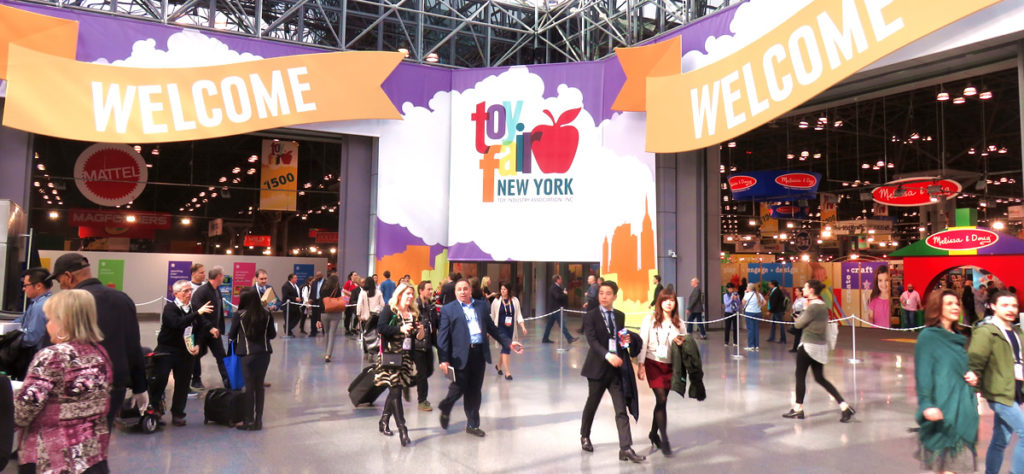
That said, most mass market toy execs that I spoke with would much prefer a showroom to the Javits Center.  Maintaining a showroom year round is less expensive than doing two shows at Javits and you get a New York office to do occasional business in to boot.   The people that I spoke with don’t like rushing to set up, rushing to tear down and rushing to pay a Teamster a couple of hundred bucks to plug an electrical cord into a socket sometime, hopefully today.  For most mass market companies a showroom in very close geographical proximity to a lot of other toy company showrooms seems to be the preferred way of doing business.  Let’s also remember that until the whole 200 5th Ave. fiasco (originally sparked by the TIA in the David Miller era), everybody spent most of the week in the Toy Building and would head over to the Javits Center and try to blow through there in a day.  Things worked pretty well for a very long time and it seems to me that a combination of showrooms in one building or two buildings that are very close to each other along with the Javits Center could work very well again.  Some companies prefer the Javits and some prefer showrooms, it seems reasonable to be able to offer both. 

Jay Foreman’s concept of a toy district sounds a little scattered but my guess is that if you asked him (and I haven’t) that what he’s suggesting is two or three buildings in very close proximity which house clusters of toy showrooms.  That could very easily work, but I would suggest a “coat test.”  If the buildings are close enough to just skip a few doors down in February without putting on a coat, fine.  If buyers (and everybody else) have to repeatedly put on and take off and possibly check and uncheck coats all day and all week, then things will likely begin to break down. 

Unfortunately, the possibility of a toy building or district has been torpedoed by the TIA’s decision to move the October Toy Show.  With only one trade show in New York the economics of a permanent showroom no longer makes sense.  First, let’s remember that the October Toy Show was first started by the Toy Building and was only hijacked by the TIA (another revenue raising opportunity!) after the building was sold.  After much rancor and debate, the entire TIA Board initially voted to keep the October show in New York.  There were apparently some complaints about scattered show sites by buyers, and I don’t doubt that there were, but just how many or how loud those complaints were has not been revealed.  One TIA board member told me that the criticism was not as forceful as people have been led to believe.  I would add that the retailers can solve this problem very easily by telling toy companies that they will be going to A and going to B (and perhaps C) and if you want a chance to meet with us you will have to be in one of those locations.  “We ain’t going to some half baked hotel room in Jersey City.”  Basically, if you are going to be at the show – BE AT THE SHOW!  Toy companies would fall into line pretty quickly.  After all, it’s in their own best interests.

Unfortunately, in an incredible display of hubris the five members of the TIA Executive Board took it upon themselves to make this decision for the entire industry.  The decision was very much out of the blue.  In fact, a quick poll taken by Playthings.com indicated that 44% of the industry was “angry.”  That’s not unhappy or disappointed or surprised, but “angry” about the decision.  It also seems strange that after the earlier vote by the entire TIA Board to keep the show in New York, that the five member TIA Executive Board hijacked this vote and unanimously elected to move the show to Dallas.  Hmmm.  There is much speculation about the motives of TIA Board Chairman Danny Grossman, a Californian and his Californian predecessor Arnie Rubin, but since this seems to be based mostly on gossip and rumor I am not going to comment here.  We do know that Mr. Grossman was quoted in Playthings as saying “The 10 largest companies don’t want showrooms in New York.”  We also know that statement is inaccurate because Jakks Pacific, through its spokesman Jay Foreman, has made it very clear that they do want a showroom in New York.

As for Mattel and Hasbro, they represent only their own interests.  For years they have not had show rooms in the Toy Building nor have they supported Toy Industry trade shows.  They know they are going to get their face time with the buyers and would prefer not to have that face time at a trade show where buyers will be distracted by their competitors. 

Danish company Lego has never really integrated with the American Toy Industry.  They do things their own way, and in fact, thinking back to my 26 years in the toy business, I don’t think they have ever hired anyone from another toy company.  All of that is fine, but is that one of the five votes you want representing the industry as a whole?  As for Robert Pasin of Radio Flyer, I just don’t know enough to comment.

One thing that does seem clear is that most of the mass market Toy Industry prefers to work out of showrooms in close proximity to each other – preferably in New York.  Leadership in the Toy Industry will not come from Mattel or Hasbro or need I mention MGA (egads!) – they have very different interests from the industry as a whole.  Leadership needs to come from the second tier companies who are big enough to have some clout but young enough to remember what it was like to be a little guy.  Spinmaster, Jakks Pacific, Mega Brands, RC2 – it’s time to stand up and take charge!

All the best,

Tom Keoughan